
‘This Is Not 1945’: UN General Assembly Opens 81st Session With Call to Restore Global Trust
USANewsOnline.Com Desk, New York — The United Nations General Assembly opened its 81st session on Tuesday with a call to restore public confidence in multilateral institutions as the world confronts wars, humanitarian crises, geopolitical divisions and the accelerating impacts of climate change.
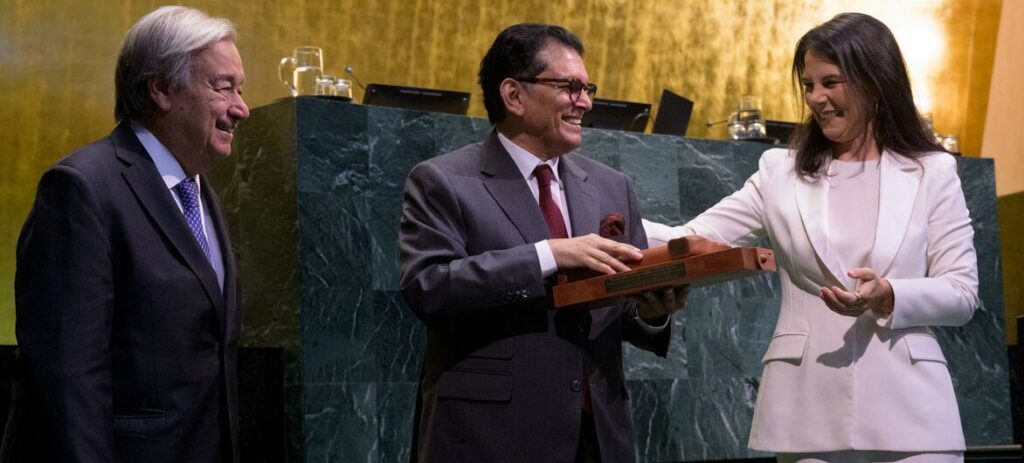
Bangladesh’s Foreign Minister and diplomat Dr. Khalilur Rahman, who assumed the presidency of the 81st session, said the United Nations must adapt to a rapidly changing global landscape and become more responsive to the challenges of the present day.
Receiving the symbolic Icelandic wooden gavel from outgoing General Assembly President Annalena Baerbock, Rahman outlined his central theme for the year: “Restoring trust, managing transformation: A United Nations that delivers for all.”
“We must make the United Nations fit for the future,” Rahman said, emphasizing the importance of incorporating the voices of civil society into global decision-making.
“We have a situation where trust is in deficit. This is not 1945. This is the 81st session. The world has moved on. The Organization must move on, and I’ll help that process,” he said.
Rahman identified six broad priorities for his presidency: strengthening peace, security and justice; accelerating progress toward the Sustainable Development Goals; addressing climate change and environmental sustainability; protecting human rights, refugees and migrants; promoting inclusive digital governance and responsible artificial intelligence; and advancing UN reform and more inclusive global governance.
The opening of the new session comes at a particularly challenging moment for the international system. UN Secretary-General António Guterres said the world is facing armed conflicts, deepening geopolitical mistrust, the risk of nuclear escalation, persistent poverty and inequality, and worsening climate-related crises.
“Rebuilding trust in the multilateral system is the defining challenge of our time,” Guterres told the Assembly. “In these tumultuous times, the global problem-solving system is more crucial than ever.”
He warned that institutions across the multilateral system, from the UN Security Council to international financial institutions, are struggling to respond effectively to the scale and complexity of today’s challenges.
Guterres also criticized the continued disregard for international law and human rights, saying geopolitical suspicion is preventing the international community from reaching effective solutions and weakening public confidence in global cooperation.
“International law and human rights – the core of our Organization – are too often flouted with impunity,” he said.
Despite those challenges, Guterres said he remained hopeful about the UN’s ability to address global problems through diplomacy, dialogue and cooperation.
“As I join you in this opening of a General Assembly session for the last time as Secretary-General, I have enormous hope thanks to the work that happens here,” he said.
The selection of the next UN secretary-general will also be a major issue during the coming year, with the new secretary-general scheduled to begin the term in January 2027.
At the closing meeting of the 80th General Assembly session, outgoing President Annalena Baerbock defended the continued relevance of the United Nations despite its shortcomings.
“I am convinced more than ever of the importance and necessity of our United Nations,” Baerbock told ambassadors.
She urged member states to consider what the world would look like without the UN, pointing to the organization’s humanitarian, peacekeeping and development work.
“In spite of its shortcomings, not a single day, not a single country, would be better off without the UN,” Baerbock said.
She cited the work of agencies such as UNICEF and UN peacekeeping missions as examples of the organization’s impact on people’s lives.
Baerbock also acknowledged the difficulty of communicating the UN’s achievements in an increasingly polarized information environment.
“Our challenge though is that in a world where hate gets six times more clicks, these positive examples can easily go unnoticed,” she said.
Who Is Khalilur Rahman?
Khalilur Rahman is a veteran Bangladeshi diplomat who left his position as Foreign Minister to assume the presidency of the 81st UN General Assembly.
Before becoming foreign minister, he served as National Security Adviser and High Representative for the Rohingya Issue in Bangladesh’s Interim Government. He has also held senior positions within the United Nations and was a founding member of East West University in Dhaka.
His presidency places Bangladesh at the center of the UN’s annual multilateral agenda at a time when the organization is under pressure to demonstrate greater effectiveness, strengthen international cooperation and rebuild public confidence in the global system.
The 81st session will now turn Rahman’s stated priorities into an agenda for negotiations among the UN’s 193 member states, with conflicts, development, climate change, humanitarian crises, technological transformation and institutional reform expected to remain central issues throughout the year. UN Photo/Manuel Elías






- বি১/বি২ ভিসাধারীদের সতর্ক করল মার্কিন দূতাবাস: জন্ম পর্যটন, চাকরি ও একাডেমিক পড়াশোনায় ভিসা ব্যবহারে নিষেধাজ্ঞা; সাংবাদিকদের জন্যও বিশেষ নির্দেশনা
- ‘This Is Not 1945’: UN General Assembly Opens 81st Session With Call to Restore Global Trust
- ‘এটি ১৯৪৫ নয়’: বৈশ্বিক আস্থা পুনর্গঠনের অঙ্গীকারে জাতিসংঘ সাধারণ পরিষদের ৮১তম অধিবেশন শুরু
- ২৫ বছর পরও ৯/১১-এর ক্ষত অমোচনীয়; নিউইয়র্ক থেকে ওয়াশিংটন, শুক্রবার আমেরিকার স্মরণ
- নিউইয়র্ক সিটি এন্ড স্টেটের লেবার মুভমেন্ট ১০০’র তালিকায় ম্যাফ মিসবাহ
- বঙ্গবীর ওসমানীর ১০৮তম জন্মবার্ষিকীতে নিউইয়র্কে ছড়া-কবিতা পাঠ ও আলোচনা
- জাতিসংঘ সাধারণ পরিষদের ৮১তম অধিবেশনের সভাপতির দায়িত্ব নিচ্ছেন বাংলাদেশের খলিলুর রহমান
- উত্তর আমেরিকার ৪১তম ফোবানা চার ভাগে অনুষ্ঠিত: আগামী বছর ওয়াশিংটন ডিসি, নিউইয়র্ক ও হিউস্টনে পৃথক সম্মেলন