
Social business to fix major problems
Nasa astronaut Ronald Garan says the theory can help overcome social and environmental challenges.

There has to be more sustainable and more powerful ways to solve some challenges, and social business is basically creating economic engines, said Ronald Garan, an astronaut of Nasa (National Aeronautics and Space Administration).
“I think capitalism has a lot of problems. On the other hand, social business can be the best way to solve the problems. It is very powerful,” he said in an interview with The Daily Star yesterday.
Garan came to Bangladesh to attend the programmes of the third Social Business Day to be held in Savar on Thursday.
He said social business — an idea championed by Nobel laureate Professor Muhammad Yunus — looks at the very social goals. It is a proper way to do social business as traditional businesses only look at making money and a very few people are making money.
“The idea is you can create social business that can help you overcome social and environmental challenges. And it is really important to do that in a way that is economic and sustainable.”
Garan was so much interested in the economic theory of the microcredit pioneer that he carried Prof Yunus’ book “Creating a World Without Poverty” to the space station where he spent five and a half months last year.
“I wanted to honour his work. This book gave quite a breakthrough which can bring change to the lives of the people,” he said.
Garan graduated from Roosevelt High School, Yonkers, NY, in 1979. He earned a Bachelor of Science degree in business economics from SUNY College at Oneonta in 1982 and a Master of Aeronautical Science degree from Embry-Riddle Aeronautical University in 1994.
He earned a Master of Science degree in aerospace engineering from the University of Florida two years later. He has been with Nasa for 12 years.
He had the opportunity to have a short-duration flight on the space shuttle Discovery back in 2008, during which he was up there for two weeks. In 2011, he was up for five and a half months on a Russian Soyuz spacecraft.
“Travelling to space is an amazing human endeavour.”
Garan, who is better-known as a social-media maven, said the invention in social media has enabled the astronauts to share their experience with the people who are not part of the journey to space.
“There are a very, very few people who got chance to go into space. We had always relied on these people to come back, give us pictures and other information and explain things to us.”
“Now, through technology and through these new platforms, we can bring people along with us on the missions and have them experience this in real time.”
“Thanks to the social media, the world is becoming much smaller and interconnected, and that has extended to space as well.”
Before his second visit, he and his team-mates came up with Fragile Oasis.
“It is not just to have it as a website where we could tell stories about space, but the goal was always to provide a platform for people to follow along on the mission, not as spectators but as fellow crew members,” Garan said.
He said a person from the earth once had helped him identify a picture. “That individual sent me background information and all the related information about the picture.”
“The social media really empowers us to do more. It makes communication much more effective.”
He said the social media has helped people get involved in space programmes. “The social media gives tremendous tools to share the experience with the people as best as we can.”
His message for Bangladeshi young talents — who want to become astronauts — is that “nothing is
impossible”.
“We have shown over and over that nothing is impossible. They can achieve whatever they want. They should study as much hard as they can and learn as much as they can so that they can help their community, country and the world, and open up immense opportunity for personal future.”
The father of three sons is also focused on Nasa’s Open Government Initiative, which aims to build stronger collaborative ties between government, industry and the general public.
“What we are trying to do is to make the government more open and transparent. Also, we are trying to make it more innovative and more collaborative and trying to engage people outside of the normal channels.”
“We realise that there are a lot of great ideas out there. We are trying to find those great ideas. Sometimes we think that we have a very traditional way of doing things. So we think that new ideas can give us creativity.”
Outside of his work at Nasa, Garan has been involved with social business activities since 2005.
He and his wife Carmel Garan run Manna Energy Ltd, a social enterprise committed to the eradication of poverty through the implementation of sustainable, environmentally sound technologies for clean energy, clean water and self-sustainable economies that foster health and education.
Manna, which plans to work throughout the world, has already developed the first United Nations Clean Development Mechanism project for drinking water treatment in developing countries.
It has also successfully developed and registered the first Gold Standard carbon credit water treatment programme, one of the largest privately financed water treatment projects in history.
Since 2007, families in rural Rwanda have had access to clean water from community-based water treatment systems installed and maintained by Manna.
“We did not rely on charities for the programme. We wanted to run it as a social enterprise which will be sustainable on its own and will do social good,” he said.
His message for the people who want to launch social business is: “Go and just do it. There are so much opportunities and things you can do. I think the whole idea spreads globally, as it has the potential to make the biggest impact in history.”thedailystar.





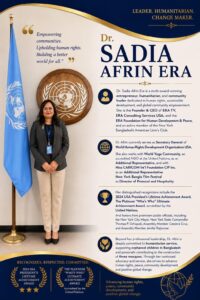



- ওয়ার্ল্ড হিউম্যান রাইটস ডেভেলপমেন্ট ইউএসএর সাধারণ সম্পাদক ড. সাদিয়া আফরিন এরা
- চরমোনাই পীরের যুক্তরাষ্ট্র সফর উপলক্ষে নিউইয়র্কে দোয়া মাহফিল, কুরআন-সুন্নাহর আলোকে বয়ান
- New York Attorney General James Secures Reimbursements for T-Mobile Customers Whose Rates Were Unjustly Raised
- নিউইয়র্কে বাংলাদেশ সোসাইটির নির্বাচনে কুনু-ফিরোজ পরিষদের সাত দফা ইশতেহার ঘোষণা; কমিউনিটি সেন্টার প্রতিষ্ঠা, সাশ্রয়ী ফিউনারেল সেবা, বিমানের সরাসরি ফ্লাইট ও আর্থিক স্বচ্ছতায় অঙ্গীকার
- ফিলিস্তিনিদের আত্মনিয়ন্ত্রণের অধিকারের প্রতি বাংলাদেশের পূর্ণ সমর্থন: জাতিসংঘে রাষ্ট্রদূত আইরিন খান
- নিউইয়র্কে বাংলাদেশ সোসাইটির নির্বাচনে প্রথমবারের মতো বিতর্ক, গুরুত্ব পেল স্বচ্ছতা ও জবাবদিহি
- New York Attorney General James Warns New Yorkers About AI-Generated Election Misinformation Ahead of November Elections
- Bangladesh calls for global treaty to protect victims of crimes against humanity