
NYC MAYOR DE BLASIO APPEARS LIVE ON NY1
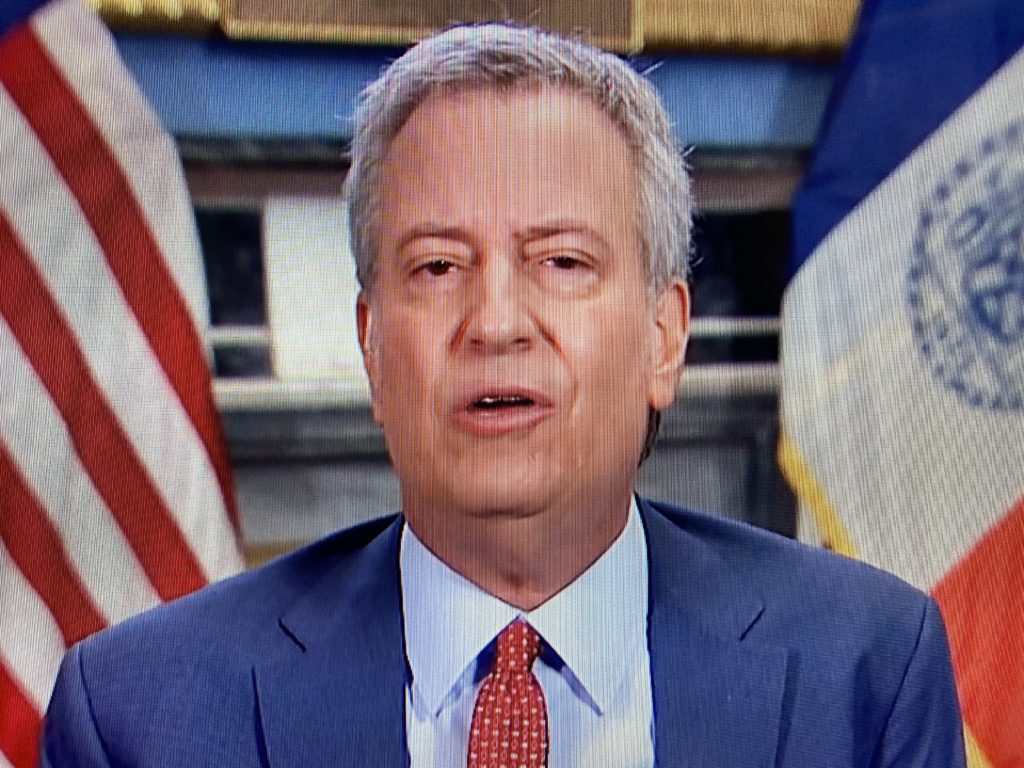
New York, March 18: Roma Torre: The number of cases of coronavirus increased today all across the state and particularly here in the city. Officials have been working rapidly to strengthen our health care system while preparing New Yorkers for a series of unprecedented disruptions to regular life. It has been another fast-moving day of developments and political anchor Errol Louis is joining me now. And on the phone, we have the very latest from Mayor de Blasio. And Mayor de Blasio, thank you so much for taking the time to speak with us. Before we get to the grim tally of cases, the Governor seems pretty adamant about rejecting your suggestion that it’s time to consider sheltering in place. So, I just have to ask you, have you spoken to the Governor yet? Mayor Bill de Blasio: Yeah, the Governor and I spoke about an hour ago and I’ll tell you about that. But first, I want to say, I want to make sure when I say shelter in place that there’s an understanding of what that means. I am referring to the model that already is happening in this country on the west coast, in the San Francisco area. It’s something – anyone who wants to get educated on this model should look at the information that’s been put out by the city of San Francisco. It’s quite a clear model where people are directed to stay home, but there’s also clear exceptions made for a essential services, and it’s clear how people should go about their lives with the maximum commitment to staying home and keeping themselves safe. But it’s a very – I think, very clearly delineated model. I think some people – and I want to take responsibility that there may have been more than one interpretation out there when I said shelter in place. I want to be explicit that I’m talking about the San Francisco model, because it actually exists right now in this country. And from what I’m seeing, it is working. It is not the same thing as, you know, closing the bridges and closing the borders. Obviously, somehow people – some people have taken it that way. We saw that a few days ago where everyone, you know, was on Twitter, talking about the potential of shutting down the city. It’s not the same thing. It is a directive to maximize people being at home to reduce all non-essential activity. But there are still very essential activities that have to continue. And there’s some leeway, of course, for people getting food and medicine and some basics. So, anyone who wants to understand it, that’s what I mean. Not some of the other, you know, very speculative ideas I think people got. The Governor and I spoke about an hour ago. It was a very good conversation. We’re going to be continuing the conversation over the next 24 hours. Look, the Governor, understandably is trying to think about the entire state and the impact of any decision on the whole state. We’re talking that through. Obviously, New York City has some very particular realities, but we’re going to talk about how to balance those factors. I think it’s important that we act as soon as possible and make decisions as soon as possible. I’m certain he feels a lot of urgency too. So, that was a very productive conversation and we’ll certainly have more to say after we continue that conversation. Torre: Can you give us an update now on the latest numbers? Mayor: Yeah. And Roma, I’m so sorry to have [inaudible] because these numbers are really growing rapidly. You know, as of the last time I spoke with members of the media last night, it was literally, you know, at that point it was 923. The Governor spoke earlier with a number in the 1,300 range. But we have the information from the last hour or so, and this is – a lot more testing is happening, to be fair, and to be clear to people – a lot more testing is happening a lot more quickly. So, certainly, we’re seeing the numbers move fast because of that, but it’s also a sobering. So, now, it is 1,871 cases for New York City alone and 11 people have passed away. So, that is a very, very sobering number. Torre: Awful. Errol Louis: Okay. Mr. Mayor, there there’s a report in the Jewish Telegraphic Agency news service that a hundred people have tested positive in the neighborhood of Borough Park. Does that identify that area as a – is that a cluster? Have your folks been able to verify that? What is going on there? Mayor: No. I can verify negatively. I spoke to our Health Commissioner probably 20 minutes ago. There is no cluster in New York City at this moment. We’re constantly monitoring. There’s a lot of activity out there, obviously. We do see some places where there’s more cases popping up and we take that seriously. But in terms of something that would equate to a cluster and, obviously the prime example we have is New Rochelle. The Health Commissioner says there are none at this point in New York City. Louis: Okay. There’s also our report, Mr. Mayor, of a case of a Correction officer on Rikers Island. And, of course, advocates have pointed out that there are approximately 900 people detained there for one reason or another who are over 50 years old and who might be especially at risk. Can you give us an update of what’s going on there? Mayor: Well, Errol, I want to make sure we’re communicating properly here. I think it was yesterday at my press conference that we talked about someone who worked for the Department of Correction, but was not a Correction officer and did not – had not been in one of the actual jail facilities recently. He passed away. That’s the latest that I have. You may have another situation, I just want to make sure we’re all speaking the same language. Torre: Mr. Mayor, the U.S. Senate just passed an aid bill that gives New York State upwards of $6 billion. And of that, I understand about a billion is going straight to New York City. What difference will that make in terms of getting services expedited to the people who need it the most? Mayor: Roma, is hugely important, but it’s only a beginning. I don’t want to ever look a gift horse in the mouth. And I’m very appreciative, and Senator Schumer went to bat for New York City in New York state and got a lot done. But we are, right now, we have immense expenses that we’re having to address, obviously, with declining revenue. It’s a really, really tough time not only for everyday people going through so much, small businesses are going through so much, but the City government is trying to do more and more with fewer and fewer resources right now, seeing what’s going on with our economy and everything. So, that’s fantastic that we got something going. What we need is a huge, huge federal stimulus far beyond what’s even being discussed now. I mean, right now they’re talking about, you know, aid to businesses, which is legitimate. I’d like to see a lot more for small business than for big business. But what really we need is for every-day New Yorkers and every-day Americans to get really substantial money back in their pocket, if not their whole income, something that is much closer to their full income, because, you know, we’re hearing about proposals like a single check for a thousand dollars – that’s not going to help people. I mean, no one will turn it down, but it’s not going to address the fundamental reality. We need something like the New Deal was during the Great Depression, because, right now – I mean, earlier today we had a federal government official talking about the potential for 2 percent unemployment. That literally starts to put you on a par with the Great Depression. So, the solution is to do what Franklin Delano Roosevelt did and go to a full-scale relief program with a huge stimulus, direct money to every-day new Yorkers and every-day Americans. And short of that, you’re going to have a lot of people who literally will not be able to afford food or medicine and we’ll have an even bigger crisis. Louis: Mr. Mayor, one of our viewers raised an issue that I’ve seen with my own eyes, which is that construction sites seem to be sort of going full speed ahead. I’ve seen some at the neighborhood level, some larger ones as well. Are they exempt from the different regulations or is the nature of their work such that it just doesn’t apply? Mayor: So far, this has been an area where, you know, we continue to consider how to handle this. I know the State is as well. And I mentioned the San Francisco model for a shelter in place – and, again, I think that San Francisco model is instructive. Even in San Francisco they allowed some leeway for construction. I think the argument is, it’s outdoors, which is a different health dynamic, workers are often more spread apart. And, obviously, anywhere where people can keep working appropriately, can keep making an income, that’s important. And whether it’s production of things we need, housing being an obvious example, there’s value in that. So, I think construction has been exempted so far for valid reasons. Whether it is going to be tightened up going forward is a different discussion. Louis: Okay. I spoke earlier today with the President of the New York State Nurses Association. She is concerned for her members that they may not have the personal protective equipment, the training and the procedures to keep them safe as they answered the call that you and others have made for them to step forward and be available for emergency work in the weeks ahead. Mayor: Look, our nurses are going to be absolutely crucial in this crisis and we need them and we depend on them and we have to protect them. One of the important things – you know, I put out an executive order ending elective surgery a few days ago and part of that, Errol, to understand is to clear the way for the focus on coronavirus. But also, it frees up personnel, it frees up beds and surgical rooms. It frees up the equipment as well. An interesting fact, just to break this news to you, we announced yesterday that we have a Medical Reserve Corps, which is retirees and others who have left the medical field but are on-call with the City Department of Health. That group was 9,000, as of yesterday. We put out the call for people to join in this atmosphere crisis, a thousand more New Yorkers with health care training who have been retired or in whatever way not involved directly in current health care – a thousand more New Yorkers signed up in less than 24 hours to join that Medical Reserve Corps. So, I think there’s a lot of people coming forward to fight this fight. We have to protect them. We’re going to make all the protective equipment and supplies we’ve got available. We’ve got a lot of surgical masks, thank God, which are applicable in this crisis. That’s the guidance we’ve gotten certainly from the World Health Organization. And we need a lot more. So, we’re trying to acquire everything we get on the private market. But this is an example where the federal government – and it’s just astounding it hasn’t happened for a crisis that’s been with us for months – the federal government needs to get to maximum production. Every factory in America that can produce surgical masks or ventilators, surgical gowns, everything needs to be ordered by the federal government into full production and then the products need to be distributed to where the need is greatest. That’s the only way we will be able to truly keep up. We have what we need for the immediate term, but if the federal government does not come in and bring the entire U.S. military with it, because they have the best logistical capacity of any organization in America – if that isn’t done immediately, I’m very worried that some point we start to run out of those basic supplies. Torre: Mr. Mayor, thank you so much for taking the time to speak with us. I know you have your hands full. Really appreciate it. Mayor: You’re very welcome. TRANSCRIPT



- নিউইয়র্কে গোল্ডেন এইজ হোম কেয়ারের ইফতার মাহফিল
- নিউইয়র্ক বাংলাদেশি আমেরিকান লায়ন্স ক্লাবের ইফতার ও দোয়া মাহফিল অনুষ্ঠিত
- নিউইয়র্কসহ যুক্তরাষ্ট্রের উত্তর-পূর্বাঞ্চলে ৭ মার্চ ঘড়ির কাঁটা এক ঘন্টা এগিয়ে যাবে
- নিউইয়র্কে জ্যামাইকা বাংলাদেশ ফ্রেন্ডস সোসাইটির বার্ষিক ইফতার ও দোয়া মাহফিল
- Radwan Chowdhury Announces Candidacy for Montgomery County Council At-Large, Launches “Five-Pillar Blueprint” for Accountable Governance.
- New York Attorney General James Reminds New Yorkers of SNAP Work Requirements
- নিউইয়র্কে ডিজিটাল ওয়ান ট্র্যাভেলস এবং বাংলা ট্র্যাভেলস এর ইফতার মাহফিল
- রূপসী চাঁদপুর ফাউন্ডেশন নিউইয়র্ক ইনক’র ইফতার ও দোয়া মাহফিল অনুষ্ঠিত